

Bringing visitors to your store is only half the battle. The real victory comes when those visitors convert — when they go from browsing to buying. Conversion optimization, often called CRO (Conversion Rate Optimization), is the systematic process of improving your ecommerce website so that a higher percentage of your traffic becomes paying customers. It’s not marketing magic or a single quick fix; it’s a mindset and a strategy rooted in understanding user behavior, reducing friction, and encouraging action.
This article breaks down how to think about conversion optimization, the tactics that actually work, and how to build a process that continually improves over time.
What Conversion Optimization Really Is
Conversion optimization is the practice of improving your online store’s ability to persuade visitors to take a desired action — most commonly completing a purchase. This involves analyzing user behavior, identifying obstacles in your funnel, testing improvements, and iterating based on real data.
Instead of focusing solely on traffic growth, conversion optimization helps you maximize the value of the traffic you already have. Even a modest increase in conversion rate can lead to significant revenue growth without increasing your acquisition costs.
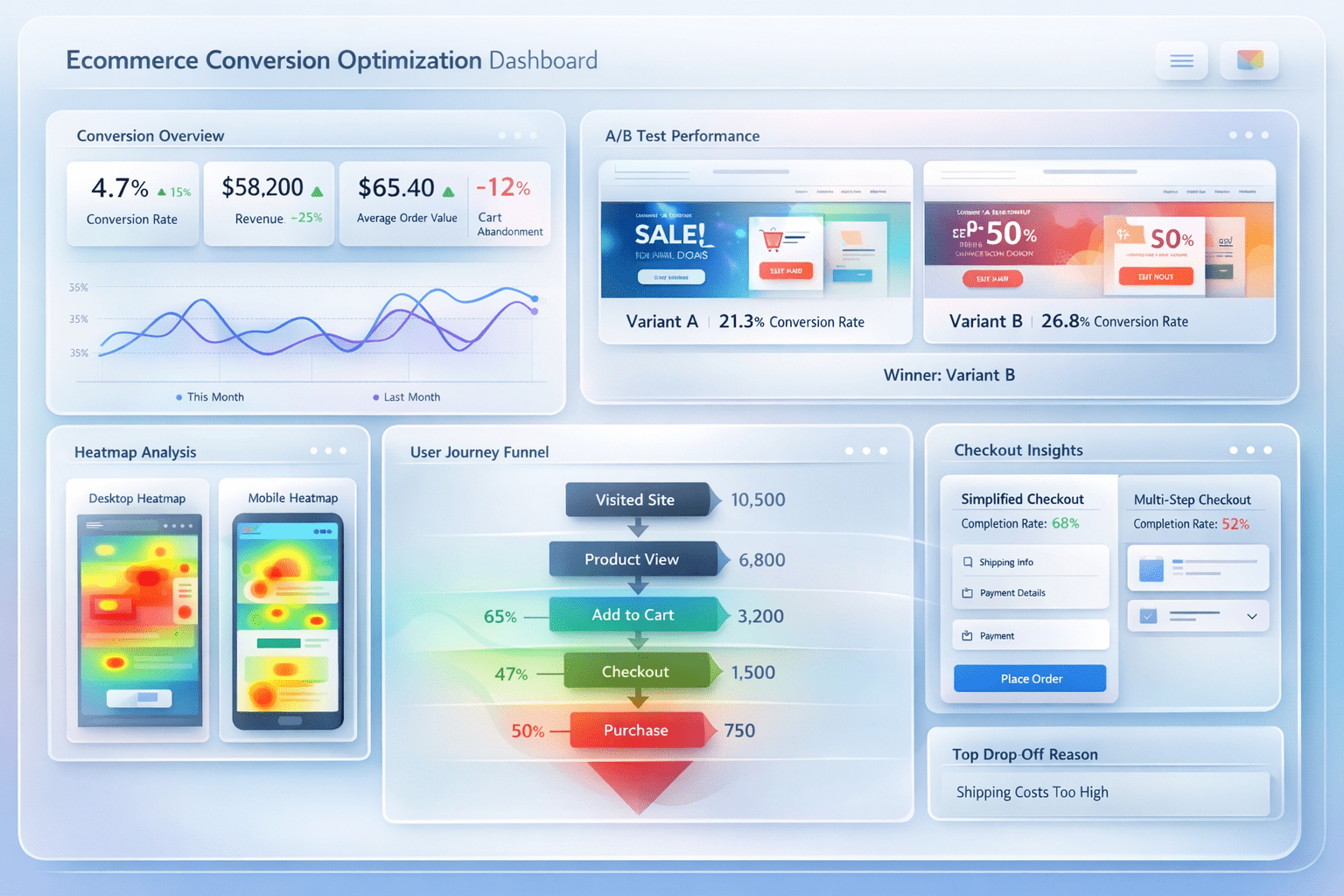
Start With Data and User Behavior Insights
Before you change anything on your site, you need to understand what’s happening right now. This begins with tracking key metrics and user paths:
- Conversion rate: The percentage of visitors who complete a purchase.
- Bounce rate: The percentage of visitors who leave immediately after arriving.
- Cart abandonment rate: The share of visitors who add items to cart but don’t complete checkout.
- Average order value: The typical spend per purchase.
- Exit pages: Where users commonly leave your site.
Tools like analytics platforms and session recording utilities provide insights into where visitors drop off, which pages are underperforming, and what actions visitors take before leaving. These insights form the foundation for meaningful optimization.
Remove Friction From the Shopping Experience
Even small points of friction — long load times, confusing navigation, unclear calls to action — can be enough to cause visitors to abandon the journey. Improving user experience is one of the most direct ways to boost conversions.
Speed and Performance
Fast load times are essential. Visitors expect pages, especially product and checkout pages, to load instantly. Slow pages frustrate users and increase bounce rates.
Intuitive Navigation
Your site should guide visitors naturally from entry to purchase. Clear filters, straightforward menus, and intuitive search help users find products faster and reduce frustration.
Simplified Checkout
Checkout should be as streamlined as possible. Remove unnecessary steps, allow guest checkout, and minimize form fields. Every extra click or question is an opportunity for a visitor to abandon the purchase.
Craft Persuasive, Clear Messaging
Visitors make split-second decisions based on what they see first. Your messaging must communicate value quickly and convincingly.
Headline and Value Proposition
Your value proposition should be immediately obvious when someone lands on your site or product page. What makes your product unique? Why should someone buy from you and not a competitor?
Product Descriptions
Clear, benefit-focused product descriptions help customers understand exactly what they’re buying and how it solves their problem. Break up text into scannable sections and highlight key features.
Visuals and Media
High-quality images and video help users visualize the product in real life. Seeing how a product works or looks on a real person strengthens confidence and reduces uncertainty.
Use Strategic Calls to Action
Calls to action (CTAs) are one of the most critical conversion drivers on your pages. They tell users exactly what step to take next.
CTAs should be:
- Clear and specific: Tell users exactly what will happen (“Add to Cart,” “Get Free Shipping”).
- Visually prominent: Use contrast and spacing so CTAs stand out.
- Action oriented: Use persuasive language that reflects the value of clicking.
Effective CTAs guide users gently but purposefully through the buying journey.
Build Trust and Social Proof
Shoppers don’t buy from sites they don’t trust. Including elements that increase credibility can have a dramatic effect on conversions.
Customer Reviews and Ratings
Displaying ratings and user reviews helps validate product quality and reduce buyer hesitation. Highlighting testimonials on product pages reinforces confidence.
Trust Badges and Guarantees
Security badges, money-back guarantees, and transparent shipping information reduce perceived risk, especially for first-time buyers.
Both types of social proof help reassure visitors that others have had positive experiences with your products and brand.
Personalization and Relevance
In 2026, personalization isn’t a nice-to-have — it’s expected. Tailoring product recommendations, landing pages, or promotions based on user behavior significantly improves relevance and conversion potential.
Personalization can take many forms:
- Showing related products based on browsing history
- Recommending items based on past purchases
- Customizing offers or messages for repeat visitors
This level of relevance makes customers feel understood and increases the likelihood of a purchase.
Test Everything With A/B Testing
Guesswork doesn’t lead to sustainable conversion gains. A/B testing allows you to try different versions of headlines, layouts, CTAs, colors, and other elements to see which performs better based on actual user behavior.
A good testing process includes:
- Defining a clear hypothesis (what you expect to improve and why)
- Testing one variable at a time
- Running tests long enough to gather statistically meaningful results
- Applying the winning variation across your site
Over time, continuous A/B testing builds a culture of data-driven improvement and leads to steady conversion increases.
Track Progress and Iterate
Conversion optimization isn’t a one-and-done task. It’s a cycle of measurement, action, testing, and refinement. As consumer behavior shifts and your traffic evolves, ongoing optimization ensures you continue to improve.
Monitor performance metrics regularly and revisit areas that show friction or drop-offs. Use heatmaps, session recordings, user feedback, and analytics to uncover new opportunities for improvement.
Small, incremental changes compound over time and yield significant results.
Incentives and Smart Offers
In some cases, thoughtful incentives can tip a visitor toward buying. Common tactics include:
- Free shipping thresholds: Offer free shipping on orders over a certain value to increase average order size.
- Limited-time promotions: Time-sensitive offers create urgency.
- First-time buyer discounts: Provide an introductory offer for new customers.
These incentives should align with your overall pricing and profit strategy, but when used strategically, they turn hesitant visitors into buyers.
The Long-Term Impact of Conversion Optimization
Conversion optimization transforms how you think about traffic. Instead of chasing ever-higher visitor numbers, you maximize the value of each visit. Even small improvements in conversion rates can lead to substantial revenue gains without increasing your marketing spend.
A well-optimized site not only converts better but also builds trust, strengthens brand experience, and turns one-time buyers into loyal customers.
By focusing on user experience, persuasive messaging, data-driven testing, and continuous refinement, you ensure that the traffic you earn works harder for your business.
